
Introduction
Machine learning projects are highly valuable and exciting areas of study in the field of artificial intelligence. These projects involve developing algorithms and models that allow computer systems to learn patterns and make predictions or decisions without being explicitly programmed.
The goal of machine learning projects is to enable computers to learn and improve from experience, similar to how humans do. This is achieved by feeding the computer with vast amounts of data, which it uses to identify patterns and derive insights. The computer then uses this information to make predictions or decisions in new and unseen situations.
There are various types of machine learning projects, including:
1. Classification Projects: These projects involve classifying data into predefined categories. For example, a machine learning model can be trained to classify emails as spam or not spam.
2. Regression Projects: These projects focus on predicting continuous numeric values. For instance, a model can be developed to predict house prices based on different features like location, size, etc.
3. Clustering Projects: These projects involve grouping similar data points together based on their characteristics. A machine learning algorithm can cluster customers into different segments for targeted marketing campaigns.
4. Natural Language Processing (NLP) Projects: NLP projects deal with processing and analyzing human language. Examples include sentiment analysis, text classification, and language translation.
5. Recommendation Systems: These projects involve building systems that suggest personalized recommendations to users. For example, an e-commerce platform can recommend products based on the user’s browsing and purchase history.
Machine learning projects typically follow a structured workflow, which includes tasks such as data collection and preprocessing, algorithm selection and training, model evaluation, and deployment. Additionally, these projects often require knowledge of programming languages like Python, data manipulation, and statistics.
Machine learning projects have diverse applications in various industries, including healthcare, finance, marketing, and transportation. They enable organizations to make data-driven decisions, automate processes, and improve overall efficiency.
As machine learning continues to advance, the scope for innovative projects in this field is expanding rapidly. From self-driving cars to personalized medicine, machine learning is revolutionizing how we tackle complex problems and make predictions based on vast amounts of data.
Uses of machine learning
Machine learning has numerous uses across various industries and domains. Here are some common applications of machine learning:
1. Image and Object Recognition: Machine learning is widely used for recognizing and classifying objects in images and videos. This technology is used in facial recognition systems, autonomous vehicles, content moderation, and medical imaging.
2. Natural Language Processing (NLP): Machine learning is used in NLP applications to understand, interpret, and generate human language. This includes tasks like sentiment analysis, chatbots, language translation, speech recognition, and text summarization.
3. Recommendation Systems: Machine learning is employed in recommendation systems that provide personalized recommendations to users. These systems are used in e-commerce platforms, streaming services, news websites, and social media platforms.
4. Fraud Detection: Machine learning algorithms can detect patterns and anomalies in large datasets, enabling organizations to identify and prevent fraudulent activities in real-time. This is utilized in financial institutions, credit card companies, and insurance companies.
5. Predictive Analytics: Machine learning can analyze historical data to make predictions and projections. This is used in financial markets, weather forecasting, sales forecasting, demand planning, and risk assessment.
6. Medical Diagnosis: Machine learning is used in medical imaging analysis to assist in the diagnosis of diseases such as cancer, retinopathy, and Alzheimer’s. It can also help in predicting patient outcomes and suggesting personalized treatment plans.
7. Autonomous Vehicles: Machine learning plays a crucial role in self-driving cars by enabling them to perceive their surroundings, make decisions, and navigate safely. It involves computer vision, sensor data analysis, and real-time decision-making.
8. Customer Segmentation: Machine learning algorithms can segment customers into distinct groups based on their behavior, demographics, and preferences. This allows businesses to tailor their marketing strategies and provide personalized experiences.
9. Cybersecurity: Machine learning algorithms are used to detect and respond to cybersecurity threats in real-time. They can identify patterns of abnormal network behavior, malware, and potential vulnerabilities.
10. Financial Analysis: Machine learning is employed in financial institutions for credit scoring, fraud detection, algorithmic trading, and portfolio management. It can analyze large volumes of financial data to provide insights and support decision-making.
These are just a few examples of the diverse applications of machine learning. With advancements in technology and data availability, machine learning is rapidly evolving and finding new applications in various fields.
Top machine learning projects
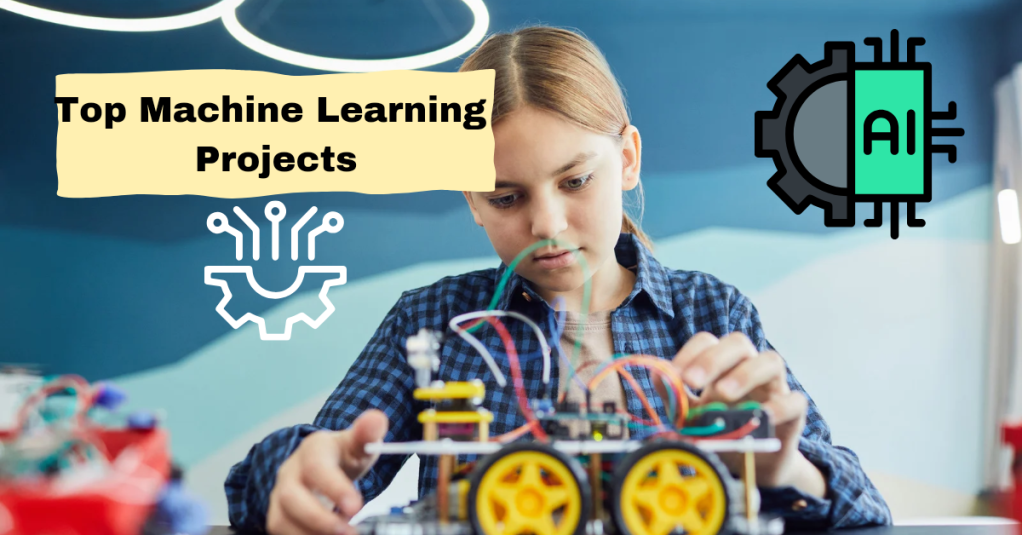
There are numerous significant machine learning projects that have made a significant impact in the field. Here are some top machine learning projects:
1. AlphaGo: Developed by DeepMind, AlphaGo is an artificial intelligence program that defeated a world champion Go player in 2016. It utilized deep learning and reinforcement learning techniques to master the complex game of Go.
2. GPT-3 (Generative Pre-trained Transformer 3): Developed by OpenAI, GPT-3 is one of the largest language models ever created. With 175 billion parameters, it can generate human-like text and perform a wide range of natural language processing tasks such as translation, summarization, and question-answering.
3. Tesla Autopilot: Tesla’s Autopilot system uses machine learning algorithms to enable partial self-driving capabilities in their vehicles. It utilizes computer vision, sensor fusion, and deep learning techniques to perceive the surroundings, navigate, and make driving decisions.
4. Deepfake Detection: Deepfakes are manipulated videos or images that appear highly realistic but are actually synthetic. Various research projects and competitions are focused on developing machine learning algorithms to detect deepfakes and combat the spread of manipulated media.
5. IBM Watson: IBM Watson is an AI-powered platform that utilizes machine learning, natural language processing, and other technologies to perform tasks like language translation, medical diagnoses, sentiment analysis, and more. It gained significant attention by winning against human competitors on the quiz show Jeopardy!.
6. FaceNet: FaceNet is a facial recognition project developed by Google that uses deep learning to create highly accurate facial embeddings and recognize faces. It has been widely used in various applications such as security, access control, and photo organization.
7. DeepMind’s AlphaFold: AlphaFold is a breakthrough project that utilizes deep learning to predict protein folding, a complex and crucial process in understanding the structure and function of proteins. It won the Critical Assessment of Structure Prediction (CASP) competition in 2018, showcasing its capabilities in protein structure prediction.
8. OpenAI Five: OpenAI developed a machine learning model called OpenAI Five that played the popular multiplayer online battle arena game Dota 2 at a high level. It showcased the ability to coordinate with human players and make strategic decisions in a complex real-time gaming environment.
9. Microsoft Project Brainwave: Project Brainwave is a deep learning acceleration platform by Microsoft that utilizes field-programmable gate arrays (FPGAs) to provide real-time AI capabilities. It aims to accelerate machine learning models and make AI more accessible for a wide range of applications.
10. Google Translate: The Google Translate project relies on machine learning techniques to perform language translation. It utilizes neural machine translation algorithms to improve accuracy and provide more natural translations across multiple languages.
These projects represent some of the most influential and remarkable applications of machine learning, pushing the boundaries of what AI can achieve in various domains.
Advanced Machine learning projects

Advanced Machine Learning Projects are as under:
1) Image classification: Develop a deep learning model that can accurately classify images into specific categories, such as identifying animals, objects, or emotions in images.
2) Sentiment analysis: Build a machine learning model that can classify textual data, such as movie reviews, into positive or negative sentiments.
3) Generative adversarial networks (GANs): Develop a GAN model that can generate realistic images, such as human faces, based on input data.
4) Speech recognition: Create a machine learning model that can accurately transcribe spoken words into text, enabling voice-controlled applications or services.
5) Anomaly detection: Build a model that can detect anomalies or outliers in large datasets, such as identifying fraudulent transactions or defects in manufacturing.
6) Reinforcement learning: Develop a reinforcement learning model to train an AI agent to play games or solve complex tasks through trial and error learning.
7) Natural language processing (NLP): Build a machine learning model that can understand and generate human-like text, such as chatbots or language translators.
8) Time series forecasting: Create a model that can predict future values in time-dependent data, such as stock prices or weather patterns.
9) Recommendation systems: Build a machine learning model that can provide personalized recommendations to users, such as suggesting movies or products based on their interests or behaviors.
10) Autonomous vehicles: Implement machine learning algorithms to enable self-driving cars or autonomous drones to navigate and make decisions in real-time.
Conclusion
The main aim of machine learning projects is to enable computers to learn and improve from experience, similar to how humans do. Also, machine learning has enabled us to work on a few advanced projects like Uber customer support, Netflix Artwork Personalization, Barbie with Brains, YouTube Comment Analysis, and The Myers -Briggs Personality Prediction.
However, if you want your project to be a top-notch, you need to have a solid planning strategy and a blueprint of your final project. With this blog, you can incorporate more into your projects and land a gig with your resume to achieve worthwhile perks.

 Digitaholic
Leave a comment